 Buy Tires
Buying Tires in Santa Ana: A First-Timer’s Walkthrough From Quote to Installation

Buying tires for the first time can feel like a lot to manage: you need the right size, a tire that suits your driving, a clear price, and a convenient installation appointment. Taking the process one step at a time makes it easier to compare options and know what to expect before you commit. Here’s how to go from figuring out what your vehicle needs to leaving The Tire Center with your new tires installed in Santa Ana. Step 1: Figure out what you need Start with the tire size recommended for your vehicle. You can usually find it on the driver-side door placard or on the sidewall of your current tire. If you’re unsure how to read the numbers, check your owner’s manual or ask a tire professional to confirm the correct fit. Then consider how you use your vehicle. Do you spend most of your time commuting, carrying passengers, or taking longer drives? Think about what matters most to you, too: a comfortable ride, dependable wet-weather traction, longer tread life, or a price that fits your budget. You don’t need to know every technical detail before you shop. Having your vehicle information and a few priorities ready is a helpful start. Step 2: Ask for an out-the-door quote A tire’s displayed price is only part of the total. Before you place an order, ask for an itemized, out-the-door quote for the tires and installation. That gives you a clearer picture of what you’ll pay and helps you spot charges that may not be included in a headline price. Ask whether the quote includes: The tires and any applicable taxes or fees Mounting and balancing New valve stems, if needed TPMS service parts, if your vehicle requires them Disposal or recycling of your old tires Any shop or service fees California also charges a tire fee on new tires; check that the applicable amount is shown on your quote or invoice. You can review the California tire fee information for details. Ask separately about wheel alignment. It is not the same as balancing, and it may not be necessary just because you’re buying tires. If your vehicle pulls to one side, the steering wheel sits off-center, or your tires show uneven wear, an alignment check can help determine whether adjustment is appropriate. You can learn more about wheel alignment services. A useful question is: “Can you confirm the full installed price and list what is included and what would cost extra?” A straightforward answer helps you compare quotes without surprises. Step 3: Browse and order through Tire Connect Once you know your tire size and budget, you can shop tires online through Tire Connect. Enter your vehicle details or tire size to see options suited to your fitment, then compare tires at your own pace from home. Tire Connect offers personalized recommendations and real-world performance information to help you evaluate your choices. The Tire Center carries leading brands including Michelin, Bridgestone, Goodyear, Continental, Toyo, and Falken. As you compare, look beyond the brand name: consider the tire’s intended use, performance characteristics, and how well those features match your priorities. When you’ve chosen a set, follow the online steps to reserve your tires and arrange an in-store installation appointment at The Tire Center in Santa Ana. If any part of the selection or checkout process is unclear, contact the shop before ordering so you can confirm fitment and the expected total. Consider financing when reviewing the total If the cost arrives at a difficult time, ask about financing through Affirm. The Tire Center offers flexible financing with no hidden fees and instant approval decisions. Review the payment terms and eligibility details before proceeding, so you understand the option that’s right for your budget. Step 4: Bring your vehicle in for installation After ordering, bring your vehicle to the scheduled appointment. The installation team will remove the old tires, mount and balance the new ones, and fit the wheels back onto your vehicle. Certified technicians handle installations at The Tire Center. If you’re searching for tire installation near me, the next step is to confirm the appointment details and ask what to expect when you arrive. The Tire Center’s online tire shopping page describes the process of entering your vehicle or tire details, choosing tires, reserving them, and scheduling installation at the Santa Ana shop. It’s also worth confirming whether your quoted installation includes any TPMS service your vehicle may need. Tire pressure monitoring systems differ by vehicle, so don’t assume that every part or sensor-related service is included unless the quote says so. Step 5: Check in on your tires after installation New tires are an investment, and regular attention can help you get the most from them. Follow the maintenance intervals in your owner’s manual, including the recommended rotation schedule. Tire rotation helps distribute wear more evenly, although the correct pattern depends on your tire setup and vehicle. Keep an eye on tire pressure, too. Use the pressure listed on your vehicle’s door placard rather than the maximum number printed on the tire sidewall. If the steering feels off, the vehicle pulls, or you notice uneven wear, ask a professional whether an alignment check or other inspection is needed. Before you leave, ask about the tire warranty and what to do if you notice a problem. The Tire Center offers warranty coverage that can include repair, refund, or replacement for tire issues, including nail damage in the tread. Confirm the applicable terms and the steps for making a warranty claim when you purchase. From your first search to the first drive Buying tires doesn’t have to be complicated. Confirm your vehicle’s tire size, decide what matters for your driving and budget, and request a clear installed quote. Then use Tire Connect to explore options, reserve your selection, and schedule professional installation. When you’re ready to get started, shop tires online or book an appointment with The Tire Center in Santa Ana. The team can help you choose a
Are Your Tires Ready for Rain? Seasonal Checks Every Orange County Driver Should Do

Orange County rain may be seasonal, but worn tires and ineffective wipers can turn a wet commute into a stressful drive. Before rainy weather arrives, take a few minutes to check your tires and windshield visibility. These simple checks can help you spot issues early, and recognize when it’s time for a professional inspection. Why tires matter on wet roads Tire tread helps channel water away from the area where the tire meets the road. When tread is worn or uneven, the tire may have less ability to clear water, which can reduce grip on wet pavement. If a layer of water builds between the tires and the road, your vehicle may hydroplane, making steering and braking less effective. Rain calls for extra care even when your tires are in good condition. Slow down when roads are wet, leave more room between you and the vehicle ahead, and avoid sudden braking or sharp steering. Be especially cautious around standing water. Check your tread before the first rainy drive Look for wear bars Park on a level surface and look at the grooves across each tire. Most tires have built-in treadwear indicators: small raised bars set between the tread grooves. If the tread has worn level with those bars, the tire needs to be replaced. Check the inside, center, and outside portions of each tire. Uneven wear can be easy to miss if you only inspect one section. A tread-depth gauge provides a more precise measurement than a visual check. The National Highway Traffic Safety Administration’s tire guidance says tires should be replaced when tread reaches 2/32 of an inch. That minimum is not a reason to wait if your tires already feel less sure in the rain or show other signs of damage. If you’re uncertain about the remaining tread, have a tire professional assess it. Notice uneven wear Look for areas that are more worn than others, including one shoulder of a tire wearing faster than the opposite shoulder. Uneven wear can point to a maintenance issue, such as a need for rotation or an alignment inspection. The pattern alone does not confirm the cause, so ask a technician to assess the tires and recommend the right next step. Check tire pressure when the tires are cold Temperature changes can affect tire pressure. As temperatures drop, pressure may fall too, so it’s a good idea to check your tires when the weather shifts and before a rainy-season trip. Use a reliable pressure gauge when the tires are cold, ideally, after the vehicle has been parked for at least three hours. Find the recommended pressure on the Tire and Loading Information label on the driver-side doorjamb or in your owner’s manual. Don’t use the maximum pressure printed on the tire sidewall as your target; that number is not the vehicle’s recommended setting. Check all four tires, and check the spare if your vehicle has one. Your vehicle may call for different pressures front and rear. If a tire repeatedly loses pressure, don’t treat repeated inflation as a fix; have it inspected. A tire-pressure monitoring system is useful, but it doesn’t replace regular checks with a gauge. Inspect tires for damage and signs of age Walk around your vehicle and look closely at the sidewalls and tread. Watch for cuts, cracks, bulges, exposed cords, or objects lodged in the tread. A bulge or exposed cord is a reason to stop driving on that tire and seek professional advice. If you find an object embedded in a tire, avoid pulling it out yourself; a tire professional can assess whether the tire can be safely repaired or needs replacement. Also pay attention to what you feel and hear while driving. Vibration, unusual noise, reduced wet-road grip, or repeated air loss can signal a problem that needs attention. Tires can age even if they have plenty of visible tread. Sun exposure, storage, use, and maintenance all affect tire condition, and age-related deterioration may not be obvious from appearance alone. Check the manufacture date on the tire identification code and consult your vehicle or tire manufacturer’s guidance about age-related inspection and replacement. A professional inspection can help you decide what to do next. Test your wipers and windshield visibility Tires are only part of rainy-weather preparation. Before the rain starts, spray washer fluid and run the wipers. Replace worn blades if they leave streaks, skip across the glass, chatter, or fail to clear water evenly. Check the rubber for splits, cracks, or obvious wear, and make sure the washer-fluid reservoir is filled. The Tire Center sells and installs windshield wipers. You can learn more about wiper selection and installation or ask for help finding blades that fit your vehicle. Know when to seek an inspection or replacement A quick driveway check is useful, but it can’t answer every question about a tire’s condition. Arrange an inspection if you notice: Tread worn level with the wear bars or close to the replacement limit A bulge, deep cut, exposed cord, or significant cracking A tire that keeps losing pressure Uneven wear, vibration, or an unusual change in handling Reduced confidence or grip when driving on wet roads An inspection can help determine whether a tire is repairable, needs replacement, or is showing wear that calls for follow-up maintenance. If replacement is necessary, ask for tires suited to your vehicle and driving needs. A quality professional tire installation involves more than fitting new tires: the tires must be appropriate for the vehicle and installed correctly. A simple pre-rain checklist Before wet weather arrives, take these steps: Check tread across all four tires, including the inner and outer edges. Look for wear bars, uneven wear, cracks, bulges, and embedded objects. Measure cold tire pressure and compare it with the vehicle’s door placard. Test your windshield wipers and top up washer fluid. Book a tire inspection if anything looks or feels unusual. When it rains, adjust your driving to the conditions. Reduce speed, increase following distance, and avoid abrupt
Your TPMS Light Is On: Here’s What It’s Actually Telling You
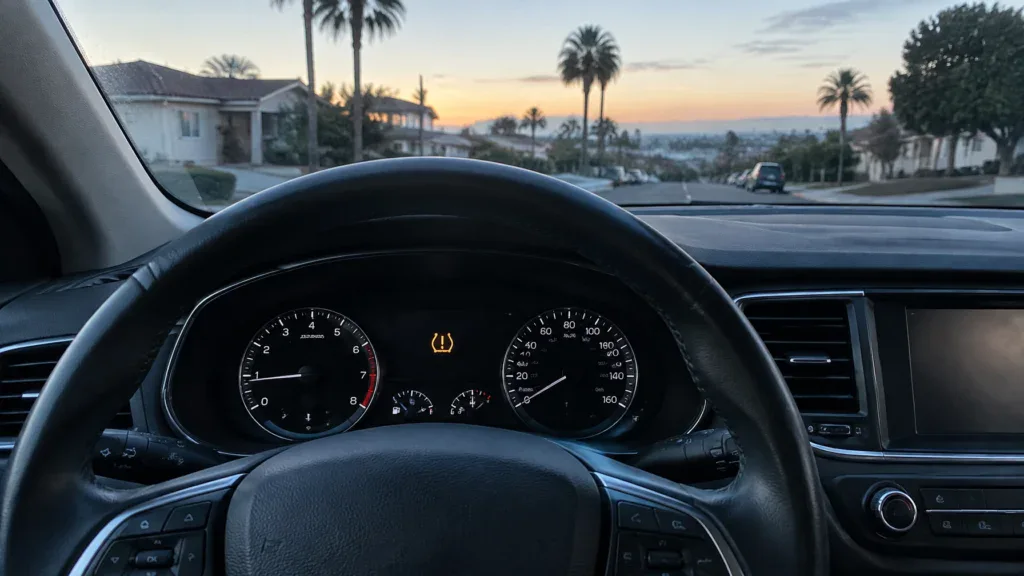
A tire pressure warning light can be easy to dismiss, especially if your vehicle still feels normal. But the TPMS light is designed to alert you before a pressure problem becomes a handling issue, tire failure, or an unexpected roadside stop. For drivers in Santa Ana, temperature changes can make the warning appear on cool mornings after a warm day. However, a solid or flashing light can also point to a slow leak, nail damage, a failing sensor, or an issue after recent tire service. Understanding what the light means helps you decide whether you need air, a tire inspection, or professional car repair in Santa Ana. What Is the TPMS Light? TPMS stands for Tire Pressure Monitoring System. Most modern vehicles use pressure sensors inside the wheels to monitor inflation. If one or more tires fall below the vehicle manufacturer’s recommended pressure, the system illuminates the dashboard warning symbol. The symbol usually looks like a horseshoe with an exclamation point in the center. It is not a replacement for a manual pressure check, but it is an important early warning. Your vehicle’s recommended tire pressure can be found on the driver-side doorjamb placard or in the owner’s manual. Do not use the maximum pressure printed on the tire sidewall as your target. That number refers to the tire’s maximum allowable pressure, not necessarily the correct pressure for your vehicle. Solid TPMS Light: One or More Tires May Be Low A TPMS light that comes on and stays illuminated usually means one or more tires are underinflated. The most common causes include: Normal air loss over time A slow puncture A nail or piece of road debris A leaking valve stem A bead or wheel leak A cold-weather pressure drop Incorrect inflation after a recent service Start by checking all four tires, even if the vehicle appears to be driving normally. The tire with the problem may not be visibly flat. A tire can lose enough pressure to trigger the warning while still looking acceptable from the outside. If the pressure is low, inflate the tire to the vehicle manufacturer’s recommended level when the tires are cold. If the warning returns shortly afterward, the tire likely has a leak that needs inspection. Flashing TPMS Light: The System May Have a Fault A TPMS light that flashes when you start the vehicle and then remains on usually indicates a system malfunction rather than a simple pressure warning. Possible causes include: A sensor battery that is reaching the end of its service life A damaged pressure sensor Corrosion around the sensor or valve stem A communication problem between the sensors and vehicle An incomplete sensor relearn after tire service A sensor damaged during tire mounting A flashing light does not necessarily mean your tire pressures are correct. Check the pressure manually, then arrange an inspection of the monitoring system. Until the problem is repaired, you should not rely on the TPMS to alert you if a tire loses pressure. The Tire Center can inspect tire pressures and help identify whether you are dealing with an inflation problem, a damaged tire, or a TPMS sensor issue. Why Cold Mornings Can Trigger the Warning Temperature changes are a common reason for a TPMS warning, particularly when a tire is already close to the low-pressure threshold. As air gets colder, it contracts. Tire pressure can drop by approximately 1 PSI for every 10-degree Fahrenheit decrease in temperature. In Santa Ana, a cool morning following a hot afternoon can create enough of a pressure change to activate the warning. You may notice that the light comes on when you first start driving and disappears after the tires warm up. As the tires roll, the air inside them heats up and pressure increases slightly. That does not necessarily mean the warning was false. It may indicate that the tire pressure was already marginally low. Once the tires cool again, the warning can return. Check your pressure when the tires are cold and adjust them to the recommended level. If the light continues to appear, have the tires checked for a slow leak or sensor problem. Common Reasons Your TPMS Light Comes On Underinflation The simplest explanation is often the correct one. Tires naturally lose a small amount of air over time, and pressure can change with temperature. Driving with underinflated tires increases sidewall flex, heat buildup, rolling resistance, and tread wear. Slow Leaks A slow leak may be caused by a small puncture, a damaged valve stem, a wheel issue, or a poor seal between the tire and rim. You may not notice a significant handling change, but the TPMS light can alert you before the pressure becomes dangerously low. Nail or Road Debris Damage Santa Ana roads and freeways expose tires to nails, screws, glass, and other debris. A puncture may leak gradually rather than causing an immediate flat. If your TPMS light appears after driving through a construction zone or over debris, have the tire inspected instead of repeatedly adding air. The Tire Center’s tire warranty coverage includes protection for eligible issues, including nail damage. Ask the team about the details of your coverage and whether repair, replacement, or other assistance applies to your situation. Sensor Battery Failure TPMS sensors use small batteries that eventually wear out. When a sensor battery fails, the system may be unable to transmit an accurate pressure reading. This is more likely on an older vehicle or when the original sensors have been in service for many years. A sensor battery generally is not recharged separately. The sensor may need to be replaced, programmed, and relearned to the vehicle. Recent Tire Service If the light appeared after a tire rotation, tire replacement, wheel change, or repair, the system may need to be reset or relearned. In some cases, a sensor may have been damaged during mounting or may not be communicating correctly. This is one reason professional tire installation near you matters. Correct mounting, inflation, balancing, sensor handling, and
Falken vs. Toyo: Which Tire Brand Is Better for Santa Ana Drivers?

Choosing between Falken and Toyo can be difficult because both brands offer dependable tires for passenger cars, SUVs, crossovers, trucks, and performance vehicles. Neither is automatically the right choice for every driver. The better option depends on how you use your vehicle, which roads you drive most often, and how much you want to spend on your complete tire purchase. For drivers in Santa Ana, the decision often comes down to daily trips on the 55 and I-5 freeways, weekend drives toward the coast, hot summer pavement, and the need for comfortable, reliable performance. The Tire Center carries both Falken and Toyo tires in Santa Ana and can help you match the right model to your vehicle and driving habits. Falken vs. Toyo at a Glance Falken and Toyo both produce quality tires across several categories, but their strengths can feel different on the road. Category Falken Toyo Best known for Strong wet traction, sporty handling, and value Comfortable ride, dry-road grip, and highway manners Popular fitments Cars, crossovers, SUVs, trucks, and all-terrain vehicles Cars, crossovers, SUVs, trucks, and performance vehicles Ride character Often balanced or slightly firm and responsive Often smooth, quiet, and comfortable All-terrain appeal Aggressive traction and durable construction Strong highway comfort and off-road capability Budget outlook Frequently competitive, especially for touring tires Competitive across touring and truck tire categories These are general brand tendencies, not guarantees for every tire. A specific Falken touring tire may ride more quietly than a particular Toyo performance tire, while a Toyo all-terrain tire may be more comfortable than a Falken model with a more aggressive tread. The exact tire model, size, load rating, and speed rating matter. How Santa Ana Roads Affect Your Tire Choice Daily driving on the 55 and I-5 Commuting around Santa Ana typically means repeated acceleration, braking, lane changes, and traffic congestion. The 55 and I-5 can expose your tires to long freeway runs, stop-and-go traffic, road debris, and uneven wear caused by heavy use. If your commute is mostly highway driving, look for a tire that provides: Stable tracking at freeway speeds Confident wet braking during winter rain Even treadwear over long distances Low road noise for a more comfortable cabin The correct load and speed rating for your vehicle Falken’s touring and all-season lines are often attractive to commuters who want a responsive feel and strong mileage coverage. Some models emphasize wet-weather grip and long tread life, which can be useful when your vehicle spends many hours each week on the freeway. Toyo’s touring tires may appeal more if your priority is a smooth, quiet ride. Their highway-oriented options are designed for drivers who want steady handling without an overly firm feel. If your commute is long and you spend significant time behind the wheel, reduced noise and ride comfort can make a noticeable difference. Hot Santa Ana pavement Southern California’s warm, dry climate is generally easy on tires compared with areas that experience severe winter weather, but heat still matters. Underinflation, overloaded vehicles, worn tread, and extended high-speed driving can increase tire stress. No matter which brand you choose, check your tire pressure when the tires are cold and follow the pressure listed on your vehicle’s door-jamb label. Do not use the maximum pressure molded into the tire sidewall as your everyday target. Also inspect for cracks, bulges, uneven wear, and objects lodged in the tread. A well-maintained Falken or Toyo tire can perform reliably in Santa Ana heat. However, choosing the correct tire category is important. A performance tire may offer sharper steering but may not be the best value for a driver who wants maximum mileage. Likewise, an aggressive all-terrain tire may add road noise and weight that you do not need for a daily commuter. Coastal trips and weekend driving Trips from Santa Ana toward Huntington Beach, Newport Beach, Laguna Beach, or other coastal destinations often combine freeway driving with winding surface roads. You may want a tire that feels stable on the highway but remains predictable when roads become more curved. Toyo can be a strong match for drivers who prefer a comfortable, composed ride on paved roads. Its performance and touring options may suit drivers who value smooth steering and dry-road confidence. Falken may be a better fit if you enjoy a more connected steering response. Certain Falken performance and crossover tires are built with handling in mind, giving the vehicle a firmer, more controlled feel during quick transitions. Neither brand should be judged solely by its name. If coastal trips are a regular part of your routine, tell the tire specialist whether you prioritize comfort, cornering response, fuel economy, or tread life. Choosing Based on Your Driving Style Choose Falken if you prefer responsive handling Falken is worth considering if you want your vehicle to feel controlled and responsive. Depending on the line, Falken tires can be a good choice for: Drivers who enjoy a sportier steering feel Frequent freeway commuters Crossover and SUV owners seeking balanced handling Drivers who want strong wet-weather performance Customers comparing mileage coverage and overall value Falken’s Wildpeak family is also well known among truck and SUV owners who want all-terrain capability. These tires can make sense if you regularly drive on dirt roads, gravel, or trails in addition to commuting. For a vehicle that stays almost entirely on pavement, however, a touring or highway tire may provide a quieter ride and better efficiency. Choose Toyo if comfort and dry-road manners come first Toyo may be the better match if you value a smooth ride and confident dry handling. It can be especially appealing for: Drivers who want lower road noise Families who prioritize ride comfort Highway commuters seeking relaxed handling SUV and truck owners who want road manners with added utility Drivers who take regular paved-road trips Toyo’s Open Country line is popular among truck and SUV drivers because it offers choices for highway, all-terrain, and more demanding applications. The correct version depends on your vehicle and how much off-road
Decoding Your Tire Sidewall: What Those Mysterious Numbers Actually Mean

When you shop for tires, the sidewall can look like it is covered in a secret code: P215/65R15 95H Those letters and numbers are not random. They tell you the tire’s type, width, shape, construction, wheel size, load capacity, and speed capability. Understanding them makes it easier to compare tires, avoid ordering the wrong size, and choose a tire that suits your vehicle and driving habits. Whether you are replacing worn tires or planning to buy tires online, learning to read the sidewall gives you a better starting point. With Tire Connect from The Tire Center, you can then use that information alongside vehicle details and real-world performance data to shop with confidence. Start With the Complete Example: P215/65R15 95H Let’s decode the example one section at a time: P = passenger vehicle tire type 215 = tire width in millimeters 65 = aspect ratio R = radial construction 15 = wheel diameter in inches 95 = load index H = speed rating The first five characters describe the tire’s basic size. The final number and letter describe how much weight it can carry and how fast it is designed to perform under specified conditions. You may see the size printed in a slightly different format, such as 215/65R15 without the “P.” That does not necessarily mean the tire is unsuitable, but you should always compare the complete tire specification with the vehicle manufacturer’s recommendation. What Does the “P” Mean? The letter at the beginning identifies the tire’s service type. P-Metric Passenger Tires The P in P215/65R15 means the tire is designed for passenger vehicles. These tires are commonly used on cars, crossovers, minivans, and some light-duty SUVs. You may also encounter other markings: LT means light truck and generally indicates a tire designed for heavier loads or demanding truck applications. T can indicate a temporary spare tire. Some tires have no letter at the beginning. These may follow a different sizing standard, so load capacity comparisons require care. Choosing the correct tire type matters because two tires with similar physical dimensions may have different construction, load capabilities, and intended uses. Your vehicle placard, owner’s manual, or Tire Connect vehicle search can help confirm the appropriate specification. “215” Is the Tire Width The number 215 represents the tire’s approximate width from sidewall to sidewall, measured in millimeters. A 215-millimeter tire is not exactly 215 millimeters wide in every application. Actual width can vary slightly depending on the wheel width and the tire manufacturer’s design. Still, the number provides the standardized size category your vehicle was designed to use. Width affects several parts of the driving experience: Traction: A wider tire may provide a larger contact area, depending on the tread and road conditions. Steering feel: Width and construction influence responsiveness. Ride comfort: Wider, lower-profile tires can feel different over rough pavement. Clearance: A tire that is too wide may contact suspension or body components. That is why simply choosing the widest tire that fits the wheel is not a smart upgrade strategy. The correct size must work with your vehicle’s suspension, wheel, gearing, and electronic safety systems. The “65” Reveals the Aspect Ratio The 65 is the tire’s aspect ratio. It means the sidewall height is approximately 65% of the tire’s width. For a 215-millimeter-wide tire: 215 × 0.65 = approximately 140 millimeters So, each sidewall is roughly 140 millimeters tall. Aspect ratio affects the balance between comfort, handling, and appearance. A higher aspect ratio usually means a taller sidewall, which can help absorb bumps and protect the wheel from some road impacts. A lower aspect ratio typically creates a shorter sidewall, which may provide sharper steering response but can transmit more road harshness. For Santa Ana drivers navigating a mix of city streets, freeway ramps, and uneven pavement, the best aspect ratio is usually the one specified for the vehicle: not simply the one that looks sportiest. “R” Means Radial Construction The R indicates radial construction. In a radial tire, the internal body cords run radially across the tire, with reinforcing belts beneath the tread. Radial construction is standard on modern passenger vehicles because it supports: Stable handling Efficient rolling Even tread wear A comfortable ride Reliable performance at highway speeds You may occasionally see other construction markings on specialized tires, but radial tires are the normal choice for everyday cars, SUVs, and crossovers. “15” Is the Wheel Diameter The 15 means the tire is designed to fit a 15-inch wheel. This measurement refers to the diameter of the wheel: not the overall outside diameter of the fully inflated tire. A 15-inch tire cannot be installed on a 16-inch wheel, even if the rest of the numbers appear close. Wheel diameter is especially important when comparing replacement tires or considering a wheel-and-tire upgrade. Changing wheel size can also change the required tire width and aspect ratio. The goal is to maintain a compatible overall diameter so the speedometer, traction control, and other vehicle systems continue to operate as intended. The Load Index Tells You How Much Weight the Tire Can Carry After the size, you may see a number such as 95. This is the tire’s load index. A load index of 95 corresponds to a maximum load capacity of approximately 1,521 pounds per tire when the tire is properly inflated and used under the specified conditions. Because a vehicle depends on four tires, the combined capacity is much greater: but you should never calculate vehicle carrying capacity from the tire number alone. Your vehicle’s manufacturer sets limits for passengers, cargo, axle weight, and overall vehicle weight. The replacement tire should meet or exceed the original equipment load index unless a qualified tire professional recommends otherwise. A lower load index can leave your vehicle without the capacity it was designed to have. That may affect handling, braking, tire durability, and safety, particularly when carrying passengers or cargo. The Speed Rating Is the Final Letter The H in 95H is the speed rating. It indicates the maximum sustained speed
Why Your EV Is Chewing Through Tires (And How Santa Ana Drivers Can Stop It)

Electric vehicles offer smooth acceleration, quiet operation, and impressive efficiency. But there is one ownership cost that can surprise new EV drivers: tires may wear out sooner than expected. For many EVs, tire wear can be approximately 20% to 30% faster than on comparable gas-powered vehicles. That does not mean every electric car will need tires 30% more often. Your vehicle’s weight, motor output, driving habits, tire selection, road conditions, and maintenance all influence the result. For drivers in Santa Ana, frequent stop-and-go traffic, potholes, tight turns, and regular freeway commuting can add even more stress. If you regularly use the 55 freeway or travel across Orange County, choosing the right EV tires and maintaining proper alignment can make a noticeable difference in safety, range, and long-term tire replacement cost. Why EVs Wear Tires Faster Battery weight increases road stress The battery pack is the main reason many EVs weigh more than similar gas-powered vehicles. That extra weight rests on the tires every mile you drive. A heavier vehicle places greater load on each tire during acceleration, braking, cornering, and impact with uneven pavement. It also increases the force acting on the tread when you make a turn or stop suddenly. Over time, that additional stress can accelerate tread wear. Weight becomes especially important on larger electric SUVs and performance models. These vehicles may require tires with a higher load rating than a similarly sized gasoline vehicle. Installing a tire that is not designed to carry the vehicle’s recommended load can lead to excess heat, uneven wear, and reduced durability. Instant torque is hard on the tread Gasoline engines typically build power progressively. Electric motors, by contrast, can deliver strong torque almost immediately. That instant response is one of the most enjoyable features of an EV: but repeated hard acceleration can also increase tire wear. When you launch quickly from a stop, the driven tires must transfer a large amount of force to the road. Even when you do not see visible wheelspin, small amounts of tread slippage can occur at the contact patch. Repeated aggressive starts gradually scrub away rubber. This effect is more pronounced in high-output EVs and vehicles with dual-motor all-wheel-drive systems. If you enjoy using your EV’s full acceleration, you may pay for that performance sooner through a higher tire replacement cost. Regenerative braking adds another source of force Regenerative braking helps recover energy and send it back to the battery. It also means the electric motor is frequently involved in slowing the vehicle, particularly when you use a strong one-pedal driving mode. That repeated acceleration and deceleration places additional longitudinal force on the tires. In urban driving, where you may speed up and slow down hundreds of times during a week, this can contribute to faster wear on the drive axle. Regenerative braking is not a reason to avoid an EV. It is simply another reason to monitor tread depth and wear patterns instead of assuming your tires will last as long as they did on your previous car. Why Standard Tires May Not Be the Best Choice for an EV Not every tire labeled as an all-season or touring tire is appropriate for every EV. The correct choice depends on your vehicle’s original specifications, including tire size, load index, speed rating, and inflation pressure. EV tires are built for a different balance EV-appropriate tires are engineered to manage several competing demands: Higher vehicle weight Strong electric-motor torque Low rolling resistance for better range Adequate wet and dry grip Reduced road noise Improved resistance to irregular wear The Chemical & Engineering News report on electric-vehicle tires explains that tire manufacturers are developing compounds and internal structures to improve wear resistance without sacrificing efficiency or traction. Some EV tires use reinforced construction or higher-load specifications. Others include design features intended to reduce road noise, which is more noticeable in a quiet electric vehicle. A tire that is excellent on a lightweight sedan may not provide the same durability or comfort on a heavier electric crossover. Highway driving exposes weak tire choices Driving on the 55 freeway creates a different set of demands from short neighborhood trips. Sustained speed, lane changes, expansion joints, and heavy traffic all test a tire’s stability and heat management. A tire that is not properly matched to your EV may wear quickly across the shoulders or center of the tread. It may also produce more road noise or reduce your driving range through higher rolling resistance. That does not mean you need the most expensive tire available. It means you should compare options based on your vehicle’s specifications and your priorities. If you commute daily, a long-wearing, high-load touring tire may be a better choice than a soft performance tire designed primarily for maximum cornering grip. You can shop tires online through The Tire Center and use Tire Connect’s personalized recommendations and real-world performance information to compare tires for your vehicle and driving needs. Alignment Problems Can Make EV Wear Much Worse Extra weight and torque already place more stress on EV tires. Misalignment adds a sideways scrubbing force that can destroy tread even faster. When toe, camber, or caster angles move outside the vehicle manufacturer’s specifications, the tires may no longer meet the road evenly. Instead, part of the tread drags across the pavement as you drive. Common warning signs include: Steering that pulls left or right A steering wheel that sits off-center Feathered or sawtooth tread edges Uneven wear on the inside or outside shoulder A vehicle that feels unsettled at freeway speeds New tires wearing noticeably faster on one axle For EV owners, a small alignment problem can become expensive because it combines with the vehicle’s weight and motor force. Hitting a pothole, curb, or piece of road debris may be enough to change the alignment. A professional wheel alignment service in Santa Ana helps restore the intended wheel angles and allows the tread to contact the road more evenly. Alignment is particularly important after installing new tires,
The Fleet Manager’s Guide to Professional Tire Services at The Tire Center

For a fleet manager in Santa Ana, the road is where your business lives or dies. Whether your drivers are navigating the heavy morning traffic on the 55 freeway or making frequent stops along the busy commercial stretches of Bristol Street, your vehicles are under constant pressure. In the world of logistics and service delivery, a single flat tire isn’t just a minor inconvenience: it’s a disruption that ripples through your entire schedule, affecting customer satisfaction and your bottom line. Managing a fleet requires more than just keeping gas in the tanks; it requires a strategic approach to maintenance that prioritizes safety and efficiency. At The Tire Center, we understand that fleet vehicles have unique needs compared to the average passenger car. From specialized fleet tire services to managing the long-term tire replacement cost across dozens of vehicles, our goal is to keep your business moving with minimal friction. Minimizing Downtime with Professional Tire Installation In the fleet industry, downtime is the enemy of profitability. Every hour a van sits in a bay is an hour it isn’t generating revenue. This is why professional tire installation is a cornerstone of any effective fleet management strategy. When you bring your vehicles to a dedicated shop in Santa Ana, you aren’t just getting new rubber; you’re getting the peace of mind that comes with certified technicians who understand the load-bearing requirements of commercial vehicles. Proper installation involves more than just mounting a tire. Our technicians ensure that every wheel is balanced perfectly and that the tire is rated correctly for the specific weight and usage of your vehicle. For businesses operating near the industrial areas of Santa Ana, where heavy loads are common, this precision is vital. A poorly installed tire can lead to vibrations, uneven wear, and eventual failure: all of which lead back to that dreaded downtime. By choosing a partner that offers same-day installation and a streamlined check-in process, you can schedule maintenance during off-peak hours or between shifts, ensuring your drivers stay on the road when they are needed most. Optimizing Tire Replacement Cost and Quality One of the most significant challenges for any fleet manager is controlling the total tire replacement cost. It can be tempting to opt for the cheapest tires available to save on upfront expenses, but in the fleet world, the “cost per mile” is the only metric that truly matters. High-tier brands like Michelin, Bridgestone, and Goodyear often provide a lower total cost of ownership because they offer superior durability and fuel efficiency. At The Tire Center, we utilize our Tire Connect online platform to provide you with real-world performance data. This allows you to compare different tires: such as the heavy-duty options from Toyo or the reliable all-season performance of Falken: to see which will hold up best under your specific driving conditions. Furthermore, we offer flexible financing options through Affirm. For growing businesses in Santa Ana that need to outfit an entire fleet at once, this can be a game-changer. You can get the high-quality tires your vehicles need today with no hidden fees and instant approval, allowing you to spread the cost over time while your fleet continues to earn. The Importance of Precision: Wheel Alignments and Fleet Safety While new tires are a significant investment, they are only as good as the vehicle’s alignment. For fleet vehicles that frequently navigate curbs or potholes in urban environments, alignment can shift quickly. A vehicle that is out of alignment will “scrub” the tires against the road, significantly shortening their lifespan and increasing your tire replacement cost prematurely. In addition to tire wear, poor alignment forces the engine to work harder, which negatively impacts fuel economy: a major concern for any fleet operating throughout Southern California. We recommend regular wheel alignments as part of your preventative maintenance schedule. Our state-of-the-art diagnostic equipment ensures that your fleet’s steering and suspension are perfectly tuned, providing a safer ride for your drivers and a longer life for your tires. Comprehensive Car Repair in Santa Ana for Fleet Longevity A fleet tire program is most effective when integrated with general automotive maintenance. You don’t want to send a vehicle to one shop for tires and another for car repair in Santa Ana. Consistency of service is key to tracking the health of your vehicles. At The Tire Center, we provide a full range of auto repair services, including: Brake Repairs: Essential for the stop-and-go traffic characteristic of Santa Ana’s city streets. Windshield Wipers: High-quality wiper sales and installation to ensure visibility during those sudden coastal rain showers. Diagnostics and Inspections: Early detection of engine or electrical issues before they lead to a breakdown on the 55 freeway. By centralizing your maintenance, you create a comprehensive service history for each vehicle. This data is invaluable when it comes time to decide whether to repair an older asset or retire it from the fleet. Protection You Can Trust: The Tire Center Warranty Perhaps the most overlooked aspect of fleet management is the protection plan. When you are managing multiple drivers, the risk of road hazards: like nail damage or impact from debris: increases exponentially. Every tire purchased and installed at The Tire Center comes with an exceptional tire warranty. Our coverage includes repair, refund, or replacement for any issues, including common road hazards. For a fleet manager, this means one less variable to worry about. If a driver picks up a nail near a construction site on Bristol Street, they can bring the vehicle in, and we will handle the repair or replacement quickly, getting them back on their route without a major hit to your maintenance budget. Streamlining Your Fleet Operations We know that your time is valuable. That’s why we’ve designed our fleet services to be as hassle-free as possible. From our online ordering system that allows you to select tires from your office to our expert guidance that helps you find the perfect fit for your specific vehicle types, we are here to act
7 Mistakes You’re Making with Your Tire Replacement Cost (and How to Fix Them)

Whether you are commuting down the 55 freeway toward Newport or navigating the busy traffic on Bristol Street, your tires are the only thing connecting your vehicle to the pavement. In the heat of Santa Ana, that connection is constantly under stress. Eventually, every driver faces the inevitable: the need for new rubber. However, many drivers find that the final bill for a new set of tires is much higher than they anticipated. It is easy to feel overwhelmed by the variety of brands, the technical jargon, and the varying price points. If you feel like you are overpaying or making a rushed decision, you are not alone. Most people approach tire shopping as a grudge purchase rather than a strategic investment. By avoiding these seven common mistakes, you can significantly lower your long-term tire replacement cost and ensure your vehicle remains safe and efficient for all your Orange County travels. 1. Waiting Until an Emergency to Shop One of the most expensive mistakes you can make is waiting until you have a blowout on the side of the 5 or a flat tire in the middle of a workday. When you are in a “desperation” mindset, you lose all your leverage as a consumer. You are forced to buy whatever is in stock at the nearest shop, often at full retail price without any manufacturer rebates. To fix this, you should start monitoring your tread depth well before it becomes a hazard. Use the “penny test” or look for the wear bars between your tread. If you start shopping when your tires are at 4/32” of an inch rather than waiting for them to go bald, you have the luxury of time. This allows you to buy tires online through platforms like Tire Connect, where you can compare real-world performance data and wait for a holiday sale or a manufacturer rebate from brands like Michelin or Bridgestone. 2. Neglecting a Professional Wheel Alignment It is a common scenario: a customer spends $1,000 on a premium set of tires but declines the alignment to “save” an extra $100. This is the definition of “penny wise and pound foolish.” If your car’s suspension is even slightly out of spec, those brand-new tires will start wearing unevenly the moment you pull out of the parking lot. Poor alignment can scrub away thousands of miles of tread life in just a few months. In Santa Ana, where potholes and uneven road construction are common, your alignment can easily get knocked out of place. When you invest in new tires, always pair them with a professional wheel alignment. It ensures that your investment lasts as long as the manufacturer intended, ultimately lowering your cost per mile. 3. Choosing the Cheapest “Off-Brand” Option When looking at the initial tire replacement cost, it is tempting to pick the cheapest tires on the rack. However, ultra-budget tires often have a much shorter lifespan and inferior wet-braking capabilities. In Southern California, we deal with extreme heat and the occasional heavy rain that turns our roads into ice rinks due to oil buildup. A mid-range or premium tire from a brand like Continental or Goodyear might cost 20% more upfront, but if it lasts twice as long and stops ten feet shorter in an emergency, the value is undeniable. At The Tire Center, we focus on helping you find that “sweet spot”: a tire that offers great performance and longevity without the premium “luxury” markup if you don’t need it. 4. Replacing Only One Tire at a Time If you get a non-repairable puncture in one tire, your first instinct might be to replace just that one. While this seems like it saves money, it can actually lead to much more expensive car repair in Santa Ana down the road. Most modern vehicles, especially those with All-Wheel Drive (AWD), require consistent tread depth across all four wheels. Having one brand-new tire with full tread alongside three worn tires can put significant stress on your drivetrain and differentials. This can lead to mechanical failures that cost thousands of dollars. Generally, it is best to replace tires in pairs (both fronts or both rears) or as a full set of four to maintain balanced handling and vehicle health. 5. Overlooking Hidden Fees and “Extras” When you see a low price advertised online or on a sign near Main Street, make sure you are looking at the “out-the-door” price. Some shops lure you in with a low tire price but then add on heavy fees for mounting, balancing, valve stems, and tire disposal. A truly cost-effective tire replacement cost should be transparent. When you work with a reputable provider, you should receive a clear breakdown of the tire services included. Look for a shop that provides added value, such as free lifetime rotations or flat repairs. These perks can save you hundreds of dollars over the life of the tires, making a slightly higher upfront price a much better deal in the long run. 6. Buying Based on Style Rather Than Driving Needs It is easy to get caught up in the look of a rugged off-road tire or a low-profile performance tire. However, if 99% of your driving is commuting from Santa Ana to Irvine for work, those aggressive tires will likely be noisy, reduce your fuel economy, and wear out faster than a dedicated touring tire. To fix this, be honest about your driving habits. Do you spend more time on the freeway or on city streets? Do you ever take your SUV into the mountains, or is it strictly a grocery-getter? Choosing a tire designed for your specific usage: like a fuel-efficient all-season tire: will save you money at the gas pump and ensure a more comfortable ride. Our team at The Tire Center uses real-world data to help you select the exact tire that fits your lifestyle. 7. Skipping the Road Hazard Warranty Many drivers view the road hazard warranty as an unnecessary add-on. However, consider the
Does Wheel Alignment Really Matter? How It Saves Santa Ana Drivers Cash at the Pump

If you’ve spent any time driving through the busy intersections of Bristol Street or navigating the morning rush on the 55 freeway, you know that keeping your car in top shape is about more than just aesthetics. For drivers in Santa Ana, CA, every trip to the gas station feels like a significant investment. With fuel prices constantly fluctuating, we are all looking for ways to squeeze a few more miles out of every gallon. One of the most overlooked factors in vehicle efficiency isn’t found under the hood or in a fuel additive; it’s actually how your tires meet the road. Proper wheel alignment in Santa Ana is one of the most effective ways to boost your fuel economy, yet it remains one of the most neglected maintenance tasks. Many people assume alignment is only necessary if the car is visibly drifting to one side, but the reality is much more subtle: and expensive if ignored. Understanding the Hidden Drag on Your Wallet Think of your car’s wheels like your own feet. If you try to walk with your toes pointed significantly inward or outward, you have to work much harder to move forward. Your muscles tire out faster, and your shoes wear down in strange patterns. Your vehicle operates on the same principle. When your wheels are out of alignment, they aren’t pointing in the exact same direction. This creates a physical phenomenon known as “rolling resistance.” When your tires are misaligned, they don’t roll smoothly; they essentially “scrub” or drag against the pavement. This resistance forces your engine to work harder and burn more fuel just to maintain a steady speed. Industry data from the U.S. Department of Energy and major tire manufacturers suggests that poor alignment can reduce your fuel economy by as much as 10%. For a driver in Santa Ana getting 25 miles per gallon, a 10% drop means you’re effectively paying for a gallon of gas every ten gallons that you never actually get to use. The Direct Connection Between Alignment and Efficiency The physics of a wheel alignment near Santa Ana are precise. Mechanics adjust three primary angles: toe, camber, and caster. Even a microscopic deviation in these angles: especially the “toe” (the inward or outward tilt of the tires when viewed from above): can have a massive impact. Imagine a tire that is off by just 0.17 inches. That might sound like nothing, but over the course of a single mile, that tire is effectively being dragged sideways for about 68 feet. If you drive 12,000 miles a year, that’s hundreds of miles of unnecessary friction. This friction doesn’t just waste gas; it generates heat that breaks down the rubber compounds in your tires, leading to “cupping” or “feathering” of the tread. At The Tire Center, we see this daily. Drivers come in for tire services thinking they just need a balance, only to find that their expensive Michelin or Bridgestone tires have been shredded from the inside out because the alignment was off by a fraction of a degree. Signs Your Vehicle Is Begging for an Alignment How do you know if you’re throwing money away at the pump? While a drop in MPG is a big clue, there are physical signs you can look for during your daily commute around Santa Ana. The Crooked Steering Wheel If you are driving straight down a level road, but your steering wheel logo is tilted to the left or right, your alignment is definitely off. Your car’s computer and steering components are fighting against the natural pull of the wheels, which leads to increased wear and tear on your steering rack. The “Drift” or “Pull” If you momentarily loosen your grip on the wheel (on a safe, flat road) and the car immediately veers toward the shoulder, you have an alignment issue. This constant “pulling” means you are constantly correcting the steering, which is not only tiring for you but puts a continuous load on the engine. Uneven Tread Wear Take a look at your front tires. Is the tread deeper on the outside edge than the inside? This “feathering” is a classic sign of misalignment. If you catch it early through professional car repair in Santa Ana, you can save the tires. If you wait, you’ll be buying a new set much sooner than the manufacturer intended. Why Santa Ana Roads Are Tough on Alignment Living and driving throughout Santa Ana presents unique challenges for your suspension. Our city is a hub of activity, which means constant road construction, heavy traffic, and the occasional unavoidable pothole. Every time you hit a curb while parallel parking near Fourth Street or strike a deep pothole after a heavy rainstorm, your suspension takes a hit. These impacts can easily knock your wheels out of their precise factory settings. Even the simple aging of rubber bushings and springs in your suspension can cause the alignment to shift gradually over time. This is why we recommend a check-up at least once a year, or every time you invest in new tires through our tire services. More Than Just Fuel: The Long-Term Savings While the focus is often on the immediate cost of gasoline, the financial benefits of proper alignment extend much further. Extended Tire Life: High-quality tires from brands like Continental or Falken are an investment. A vehicle with perfect alignment ensures that the weight is distributed evenly across the entire contact patch of the tire. This allows the tread to wear down at the rate the manufacturer promised, often doubling the life of the tire compared to a misaligned vehicle. Suspension Protection: When wheels are misaligned, they don’t absorb road shocks as they should. This extra vibration and stress are transferred directly to your shocks, struts, and ball joints. Fixing an alignment is significantly cheaper than replacing a blown strut or a damaged steering rack. Safety and Handling: In an emergency maneuver, you need your car to respond instantly. Misalignment can cause “darting” or
How to Choose the Best Tires for Your SUV: Premium vs. Budget Brands Compared

If you have spent any time driving around the busy streets of Santa Ana, you know that your SUV is more than just a vehicle: it is a mobile office, a family shuttle, and a weekend escape pod all rolled into one. Because SUVs are heavier and have a higher center of gravity than standard sedans, they put a unique set of demands on their rubber. When it comes time to replace them, you are inevitably faced with a choice: do you invest in premium rubber from brands like Michelin or Bridgestone, or do you save a few hundred dollars with a budget-friendly alternative? Choosing the best tires for SUV models requires looking past the initial price tag. While the upfront savings of a budget brand are tempting, the long-term implications for safety, comfort, and your wallet are significant. In this guide, we will break down the real-world differences between premium and budget SUV tires to help you make an informed decision for your vehicle and your family. Why SUV Tires Are Different Before we dive into the brand comparison, it is important to understand why choosing the right tire for an SUV is more critical than for a compact car. SUVs are heavy. Even a mid-sized crossover can weigh upwards of 4,000 pounds, and full-sized models often exceed 6,000 pounds. This weight creates immense pressure on the tire sidewalls, especially during cornering and braking. Furthermore, SUVs are often used for hauling cargo or towing trailers, which adds even more stress. A tire designed for an SUV must have a reinforced structure to handle these loads without compromising stability. When you search for tire installation near me in Santa Ana, you want to ensure you are working with experts who understand load ratings and speed ratings specific to your vehicle’s weight class. Premium Brands: The Gold Standard of Performance When we talk about premium brands, we are looking at the “Big Four”: Michelin, Continental, Bridgestone, and Goodyear. These companies invest billions into research and development to create rubber compounds that shouldn’t technically be able to do what they do: provide incredible grip while also lasting for 70,000 miles. Safety and Braking Distance The most significant advantage of premium tires is safety. In emergency situations, the difference between a premium tire and a budget one can be measured in feet: and those feet matter. Independent testing has shown that premium tires can stop an SUV up to 20 feet shorter on wet pavement compared to budget alternatives. In a city like Santa Ana, where sudden stops in traffic are common, that 20-foot margin is often the difference between a close call and a costly fender bender. Ride Quality and Road Noise Premium tires are engineered with advanced tread patterns designed to cancel out road noise. Because SUVs have large cabins that can act like echo chambers, tire roar can become incredibly annoying on long drives. High-end tires often feature “silencer” grooves and specialized internal belts that soak up road vibrations. If you value a quiet, luxurious ride, premium is the way to go. This attention to detail also affects tire noise and ride comfort in a way that cheaper tires simply cannot replicate. Longevity and Warranty Premium manufacturers stand behind their products. It is common to see treadwear warranties of 60,000 to 80,000 miles on top-tier SUV tires. These tires use silica-enriched compounds that resist heat and wear, ensuring that the tread stays effective for years rather than months. Budget Brands: Savings or Sacrifice? On the other side of the spectrum are budget tires. These are often produced by lesser-known manufacturers or are older designs that have been licensed out. While they meet the basic safety standards required by law, they rarely exceed them. The Trade-off in Grip Budget tires typically use simpler rubber compounds. To make a tire cheap, manufacturers often use more “carbon black” and fewer expensive polymers and silica. The result is a tire that is harder and less flexible. While this might be okay on a dry, sunny day, these tires can struggle significantly in the rain or during cold snaps. The rubber hardens, losing its “tackiness” and making the SUV prone to hydroplaning or sliding. Shorter Lifespan While you might save 40% on the initial purchase, budget tires often wear out twice as fast. Many budget SUV tires lack a mileage warranty entirely, or they are rated for only 25,000 to 30,000 miles. For a high-mileage driver in Southern California, this means you will be looking for tire installation near me much sooner than you expected, potentially wiping out any initial savings. The “Value” Tier: Finding the Middle Ground There is a third category that many drivers overlook: the value tier. Brands like Falken, Toyo, and Kumho offer a fantastic balance. They provide much of the technology found in premium tires: like high-silica compounds and modern tread designs: but at a price point that is easier to swallow. For many SUV owners in Santa Ana, a brand like Falken offers the perfect “Goldilocks” solution. You get the 3-Peak Mountain Snowflake rating for occasional trips to the mountains, a solid 60,000-mile warranty, and wet-weather performance that far exceeds the “no-name” budget brands. The “Math of the Mile”: Why Premium Often Costs Less Let’s look at the actual cost of ownership. It is easy to get sticker shock when you see a set of four premium tires for $1,000 compared to a budget set for $600. However, if the premium set lasts 75,000 miles and the budget set lasts 35,000 miles, the math changes completely. Premium Set: $1,000 / 75,000 miles = 1.3 cents per mile Budget Set: $600 / 35,000 miles = 1.7 cents per mile When you factor in that you have to pay for professional mounting and balancing twice for the budget tires, the “cheap” option actually becomes the most expensive way to keep your SUV on the road. Additionally, regular tire maintenance on a high-quality set of tires ensures you get every bit